How Much Electricity Does an Air Cooler Use?
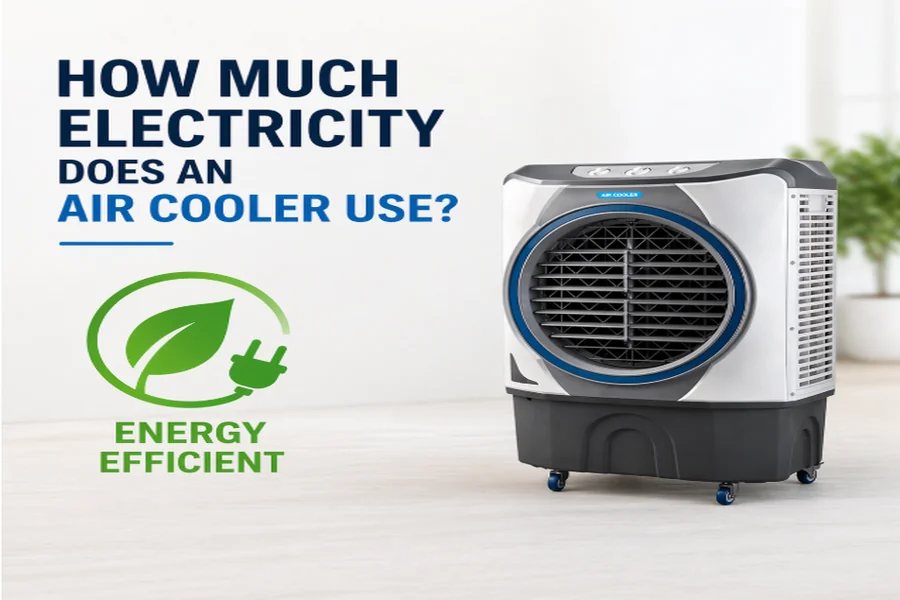
Summer heat sucks. If you want an affordable way to cool off without massive electricity bills, then look no further than an air cooler. But before you buy one, you will probably want to know how much electricity it uses. Air coolers are extremely efficient, but let’s break down how much electricity an air cooler uses in simple terms.
What Is an Air Cooler?
An air cooler is an appliance that cools the air through water and a fan. The warm air enters the appliance, gets cooled through the wet cooling pad, and exits the unit as cool air. It basically creates a continuous cycle using evaporative cooling technology.
Small air coolers are designed for personal use and can be placed on your desk at work or school. Larger air coolers are meant to cool bedrooms, and bigger desert coolers can cool open areas.
How Many Watts Does an Air Cooler Use?
Air coolers typically range from 100 watts to 300 watts. The smaller personal air coolers use about 7 watts to 12 watts, while mid-range air coolers usually hover around 150 watts to 200 watts. The largest desert coolers can run anywhere from 300 watts and higher.
Compare that to a normal air conditioner, which runs anywhere from 1,000 watts to 3,000 watts per hour. That means an air cooler uses up to 90% less electricity than an AC unit, which is why many people opt for an air cooler instead of buying an air conditioner.
How to Figure Out Electricity Cost
You do not need to be good at math to understand how much something costs to run. In fact, there is a simple equation you can follow.
(Wattage) x (hours used per day) / 1000 = kWh Used per day
For example, let’s assume you run your air cooler for 8 hours per day.
200 watts x 8 hours = 1600 / 1000 = 1.6 kWh per day
Now let’s find the monthly kWh used.
1.6 kWh x 30 days = 48 kWh per month
The average electricity cost in America is around $0.16 per kWh. At that rate, it would cost you about $7.68 per month to run your cooler.
$7.68 / $0.16 = 48 kWh per month
That is a tiny amount to keep cool compared to running your air conditioner. Your central air conditioner, using the same settings, could cost you $50 to $150+ a month.
Factors that Influence Electricity Usage
Air coolers can vary depending on model and brand in how much electricity they use. Here are some factors that can change how much electricity your air cooler will use.
-
Fan Speed
Most air coolers have at least 2 or 3 fan speeds. The higher the fan speed, the more electricity it uses. You will use more electricity leaving your air cooler on high for the entire day, than leaving it on low or medium.
-
Room Size
If you have a small cooler and try to cool a large room, it will work harder and run longer using more power. Make sure you have the right-sized cooler for the room you are cooling.
-
Outdoor Temperature
On extra hot days the cooler will have to work harder, which can use slightly more electricity. This will be more noticeable if you have a larger air cooler.
-
Age and Condition of Cooler
An older air cooler that has never been cleaned will not run as efficiently as one that is well kept. If the cooling pads are dirty or the fan is starting to wear out, then it can cause the motor to work harder which increases power usage. Make sure you clean your air cooler often to reduce electricity use.
-
Additional Features
Some air coolers come equipped with extra features like remote controls and timers. While these features do not use a lot of electricity if you use a timer, it can help limit your run time and lower your electricity bill.
Air Cooler vs Air Conditioner: Electricity Usage
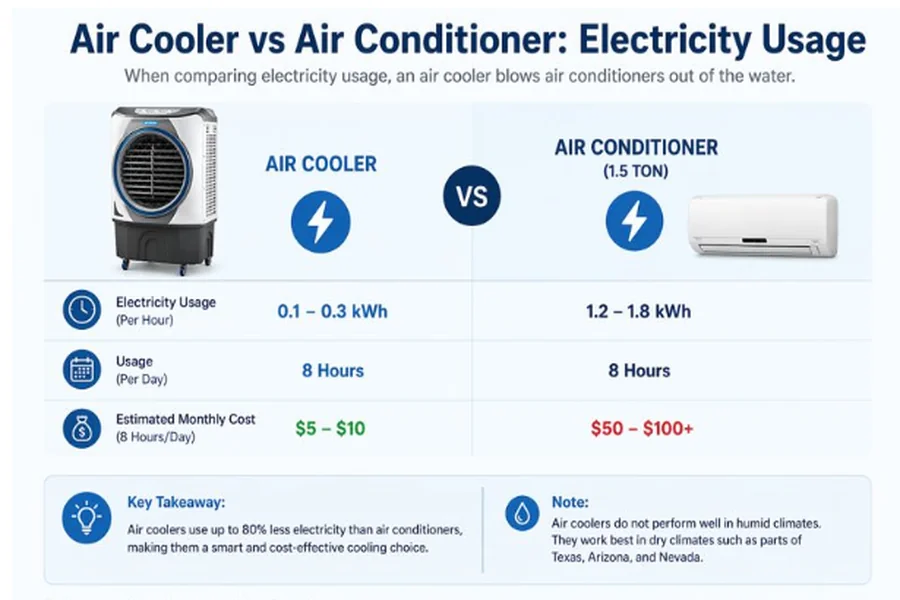
This graph is for those trying to decide whether to get an air cooler or air conditioner. When comparing electricity usage an air cooler blows air conditioners out of the water.
On average, a 1.5 ton air conditioner will use anywhere from 1.2 kWh to 1.8 kWh per hour. An air cooler uses about 0.1 kWh to 0.3 kWh per hour.
Running your AC for 8 hours a day over the course of a month can cost you anywhere from $50 to $100+. Running an air cooler for the same amount of time can cost as little as $5 to $10.
Keep in mind that air coolers do not perform well in humid climates. If you live in an area with year round humidity it may not be as effective. They work great in dryer climates such as parts of Texas, Arizona, and Nevada.
Tips to Lower Air Cooler Electricity Usage
There are some ways you can improve your air coolers efficiency.
- Only use your air cooler in a well-ventilated room. Crack a window to allow some hot air to escape.
- Fill with cold water before turning it on. Adding ice or cold water to the water tank allows your air cooler to have a head start and not have to run as long.
- Regularly clean your cooling pads. Prevent dirt and grime from blocking air flow and forcing the motor to work harder.
- Use a timer if you have one. Air coolers are most expensive when it comes to hours used. Set a timer to where you are only running it when you need it.
- Size always matters. No matter what you buy, the right size for the room is always going to be more efficient than one that is too small or too big.
Blog Case Study: UK Family Lowers Cooling-Related Energy Usage with Air Cooler
Last summer, a young couple living in Manchester in an apartment with one bedroom noticed their electricity bills creeping up. They had been using an ordinary portable air conditioner in their living room for the past few hours daily since UK summer temperatures had soared higher than usual.
Problem
- Portable air con using approximately 1.2–1.5 kilowatt-hours (kWh) per hour
- Operated for 6–8 hours per day
- Costing them over £70 per month at peak summer period
They were looking for a cheaper alternative.
Solution
The family swapped their air conditioner for a mid-sized air cooler (of roughly 180 watts). They also:
- Left one window open a crack
- Operated the cooler during the hottest times of day only
- Cleaned and maintained the cooler frequently
Results
- Energy consumption reduced from nearly 9–12 kWh per day to 1.2–1.5 kWh
- Electric bill lowered to around £8–£12 per month
- Stayed cool and comfortable inside on mild hot days
- Overall reduction in kWh used per month
Moral of the Story: Air coolers may not be as strong as air conditioners, but they use significantly less electricity and can help you save on energy costs in the UK’s mild weather.
Link: https://vocal.media/01/5-ways-an-air-cooler-can-save-energy-while-keeping-your-space-cool
Air Cooler FAQs
1. Do air coolers use a lot of electricity?
Air coolers use on average 0.1 kWh and 0.3 kWh per hour. It depends on your cooler’s size and the speed you run the fan at.
2. How much electricity does an evaporative cooler use?
As little as 80–90% less than a traditional air conditioner.
3. How much does it cost to run an air cooler?
Air coolers cost roughly £5 – £15 a month to run if used 6–8 hours daily.
4. How many watts does an air cooler use?
Air coolers typically range from 100–300 watts.
5. Are air coolers energy efficient?
Yes. The average air cooler typically uses only 0.1–0.3 kWh per hour.
6. What affects how much electricity my air cooler uses?
Factors that affect how much electricity your air cooler consumes include:
- Fan speed
- Area of the room
- Outdoor heat
- Cooling pad condition
- Hours used per day
7. Is there anything else I can do to decrease how much electricity my cooler uses?
Yes…
- Avoid running it at high speeds unless necessary
- Limit how long you use it each day
- Leave a window open for ventilation
- Clean the pads frequently
8. Will an air cooler work in my house?
Yes. As long as your house is well ventilated and the weather is only moderately warm. Air coolers are less effective on extremely humid days.
Final Words
Air coolers are one of the least expensive ways to keep cool in the summer. A normal air cooler uses between 100 watts to 300 watts and averages around $7 dollars per month to run. They use significantly less electricity than a normal air conditioner and can save you hundreds on your cooling bills if you use them right. Air coolers are great if you live in a dry climate and want to save money.