Best Japanese Knife Set: The Complete Gift Guide (2026)
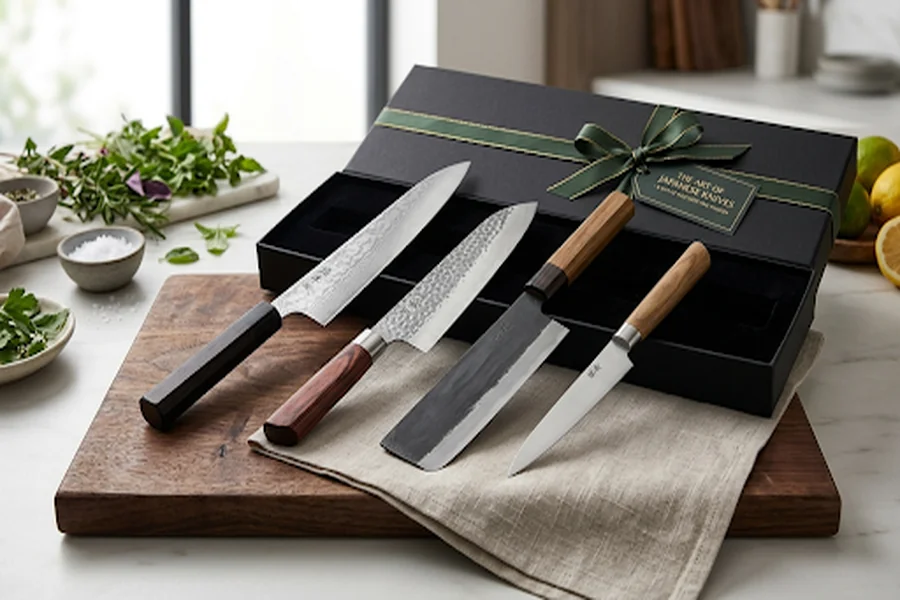
You want to give a gift that actually means something, something that will be used every day, that improves with time, and that says you paid attention. A Japanese knife set checks every one of those boxes.
But standing in front of the options available dozens of blade styles, several steel families, finishes with unfamiliar names enthusiasm can quickly turn into confusion. Which formats should you choose? What steel suits which cook? Is a full Japanese knife set the right call, or is it better to handpick two or three exceptional pieces?
This complete gift guide walks you through everything: recipient profiles, essential blade formats, selection criteria, and the questions worth asking before you buy whether you are shopping for a home cook or a professional chef.
Why Give a Japanese Knife Set?
A Japanese knife is not a standard kitchen tool. It is an object with character, hand-forged by craftspeople whose expertise passes from generation to generation. Unlike mass-produced Western knives, each Japanese blade is the result of a meticulous process: steel selection, heat treatment, sharpening, and finishing.
Giving a Japanese knife gift set is giving something tangible and lasting — a gift the recipient will reach for every day, that will develop a patina over time, and that signals genuine attention to their interests and passions.
For cooks who care about precision and technique, or for anyone looking to take their cooking to the next level, a well-composed set represents a meaningful investment far removed from single-use gadgets that end up forgotten in a drawer.
The Essential Formats in a Good Japanese Knife Set
Before composing a set, it helps to understand what each blade format actually does. Here are the four knives that form the foundation of a versatile Japanese knife set.
The Gyuto — The Japanese Chef’s Knife
The Gyuto is the Japanese equivalent of the Western chef’s knife. Its long blade — typically between 210 mm and 270 mm — and its versatility make it the centerpiece of any set. It excels at slicing meat, mincing vegetables, and working with herbs with precision.
It is almost always the first Japanese knife recommended, and for good reason: it adapts to nearly every kitchen task. For a cook who does not yet own a Japanese blade, a well-chosen Gyuto can fundamentally change their experience of cooking.
The Santoku — Compact Versatility
The Santoku — literally “three virtues” — is designed for slicing, dicing, and mincing. Its shorter blade and flatter profile make it particularly pleasant for vegetables and fish. It suits cooks who prefer a compact, highly maneuverable knife.
In a japanese knife set, the Santoku complements the Gyuto well: where the Gyuto shines on larger cuts and longer strokes, the Santoku takes over for delicate prep work and everyday vegetables.
The Nakiri — The Japanese Vegetable Knife
The Nakiri is a rectangular-bladed knife dedicated exclusively to vegetables. It’s straight-edge cut sections cleanly without crushing plant fibers — a significant advantage for brunoise, julienne, and paper-thin slices.
For a cook whose diet leans heavily toward vegetables, the Nakiri is a valuable addition to any set. It is not a universal blade, but where it operates, nothing else quite compares.
The Petty — The Precision Blade
The Petty is the Japanese utility knife. It’s fine, pointed blade, between 120 mm and 180 mm handles precision tasks that larger knives cannot: peeling, trimming, filleting small fish, and working delicate herbs.
In a Japanese knife kit built for a detail-oriented cook, the Petty often ends up as the most-reached-for blade precisely because it goes where the big knives cannot.
Choosing the Steel: What the Finish Actually Tells You
Steel is what sets Japanese knives apart from one another. Two major families exist: stainless steels (VG-10, SG2, Ginsan) and traditional carbon steels (Aogami, Shirogami). Each has real advantages depending on the cook’s profile.
Stainless steels like VG-10 and SG2 offer excellent corrosion resistance and require less maintenance ideal for a home cook or someone just beginning their journey with Japanese knives. Carbon steels like Aogami and Shirogami achieve an exceptional edge, but ask more of their owners: dry immediately after use, apply a light coat of oil, and store properly.
To explore the full range of blade types and find the set that fits the recipient’s level and habits, browse the complete Japanese knife collection — organized by format, use, and maker.
Four Recipient Profiles to Guide Your Choice
The best Japanese knife set is the one that matches the person who will use it. Here are four common profiles and the combinations that suit them.
- The curious home cook: a Gyuto in VG-10 or Ginsan, optionally paired with a Petty. Stainless steel, Kurouchi or Nashiji finish for simplified care. The goal: discover Japanese knives without being intimidated by maintenance.
- The plant-forward cook: a Nakiri paired with a Santoku. These two blades cover the full range of vegetable prep with a precision no Western knife can match.
- The experienced cook ready to level up: a Gyuto in Aogami or SG2 Damascus, with a matching Petty. These steels demand more attention but reward the owner with an edge that has to be felt to be believed.
- The professional chef or culinary student: a Gyuto + Petty + Yanagiba for fish-focused work, or Gyuto + Honesuki for butchery. Specialized blades that match the precise gestures learned in a professional kitchen.
Maintenance: The Criterion Most Gift Guides Skip
A Japanese knife set only holds its value if the blades stay sharp. Sharpening on a water stone is the recommended method for Japanese knives — it respects the blade’s angle and preserves the edge geometry. Electric sharpeners and honing rods are not suited to these harder steels.
If the person you want to treat has never sharpened a Japanese knife, consider pairing your gift with an introduction to proper care. A professional water stone sharpening service is an excellent way to bring any blade back to peak condition — or to ensure a new knife starts its life at its absolute best.
For storage, a wooden block, magnetic knife rack, or individual sayas (wooden blade guards) protect the edge far better than a drawer, where blades knock against each other. A simple but essential complement to any Japanese knife investment.
The Right Set Is the One That Fits Its Owner
There is no single best Japanese knife set. The right gift is the one that accounts for the recipient’s level, their cooking habits, and the care they are willing to give their blades. A stainless steel Gyuto suits someone who cooks every day and doesn’t want to worry about rust. An Aogami set rewards the enthusiast who finds pleasure in the maintenance ritual.
What matters above all is the fit between the blade and its user. A well-thought-out set — even one with just two knives — will always outperform a full block of mismatched blades.
Who are you shopping for — a home cook just starting out, or a seasoned enthusiast ready for their next obsession? Share the profile in the comments, and we will help you find the right combination.